Mistaken Assumptions: My Accidental Signature Move

Last week, after being stuck on it for well over a month, I finally finished the midpoint chapter—chapter 12 of a probable 24—of Every Rose that Blooms.
For anyone who’s been around for a while, you know that me getting stuck at the midpoint of any writing project is a fairly common occurrence.
It’s just how my brain works—starting out, I can see the shape of the first quarter to a half, so I can usually write that fairly quickly. But then I get to the midpoint (which I don’t see as a “mushy middle,” because I know exactly what needs to happen there, just not how best to execute it), and I stall out while my brain figures out the back half.
In the process, I’m also revising the front half based on what I now know about the characters, their Lies, conflicts, wounds, etc., much of which I was figuring out on the fly as I wrote. I’m nearly incapable of moving forward in a story when I know there’s a major problem that needs to be fixed earlier in the manuscript—simply writing a note to fix it in revisions isn’t good enough. It must be fixed now, because the manner of fixing it may affect what happens moving forward.
This is also the third of what was originally going to be six books in the Peace Crossing series. So not only did I need to figure out the back half of this book, I also needed to figure out the back half of the series well enough that I could ensure I was seeding in future characters and conflicts appropriately. So, yeah, I did that in that six weeks, too.
And I realized I had one more couple than planned books. So… now there will be seven books. (Yay!)
Discovering My Trope Fallback
While writing the second half of Chapter 12 last week, I recognized a trope that I’ve used in every single one of my contemporary romances: mistaken assumptions. One or both characters starts the story believing something false about the other person that prevents them from being together. These false assumptions get cleared up at the midpoint, allowing the characters to move into a more intimate relationship during the second half.
What can I say? As a tension engine, it works, and clean romances need a darn good reason (or three) for those characters not to slide too quickly into physical intimacy. I’m not sure what part of my subconscious this is pulling from (though you can bet I’ll be thinking about it).
But now that I’ve seen it, I will definitely may or may not use it again. :-)
Stretching my Writing Comfort Zone

Something I am doing differently with this book that has been a challenge is using a completely different driving romance trope—instead of my old standbys of second-chance romance or friends-to-lovers, I’m writing a pining hero.
This has been tough, because pining heroes can easily come off as simps.
How do you write someone who has been too risk-averse to go for the girl he’s in love with without making him seem like a coward? How do you show his strong, masculine, and attractive qualities without making it unbelievable that he wouldn’t have said something to her in all the time he’s been interested?
And how do you show him as pining without having him place the girl on a pedestal she could never actually be worthy of and is bound to fall from at some point—to make sure he’s in love with a real person, not an ideal?
In some ways, this isn’t so different from some of my second-chance heroes. Caleb in Every Star that Shines never really got over his high school sweetheart Delanie, but he set those feelings aside because of duty and responsibility, and because he was a good man who committed to his family. Noel in Every Bell that Rings was attracted to Steph for years, but held back because he didn’t trust himself to be in a relationship with anyone, and because he’d been so badly wounded by a previous girlfriend that he didn’t want a repeat of that experience.
Luke is different. His challenge is that he is genuinely risk-averse. He dreams of a career as an artist, but doesn’t handle criticism well and doesn’t believe his art is good enough to be commercially viable. He wants to tell Maddie how he feels, but he’s afraid of rejection, since he’s not her usual type.
On the other hand, he’s a dutiful son, a helpful friend, and a compassionate pet owner. (Writing his dog, Timber, has been a true joy.) He works hard. He finds beauty everywhere. And he sees things in Maddie that she struggles to see in herself.
Helping these two bring out the best in each other has been a delight. Figuring out how to do it in a way that makes us root for both of them has been a challenge. But now that I have a good stable foundation, I’m looking forward to writing to the end of the book—which is usually the fastest part of the process for me.
And then it was summer…
A month ago, there was snow piled higher than my deck in my yard. Today, we’re supposed to hit 27° C. (For the Americans in the crowd, that’s 81° F—or, for people in this part of the world who don’t have central AC, like us, blinkin’ hot.)
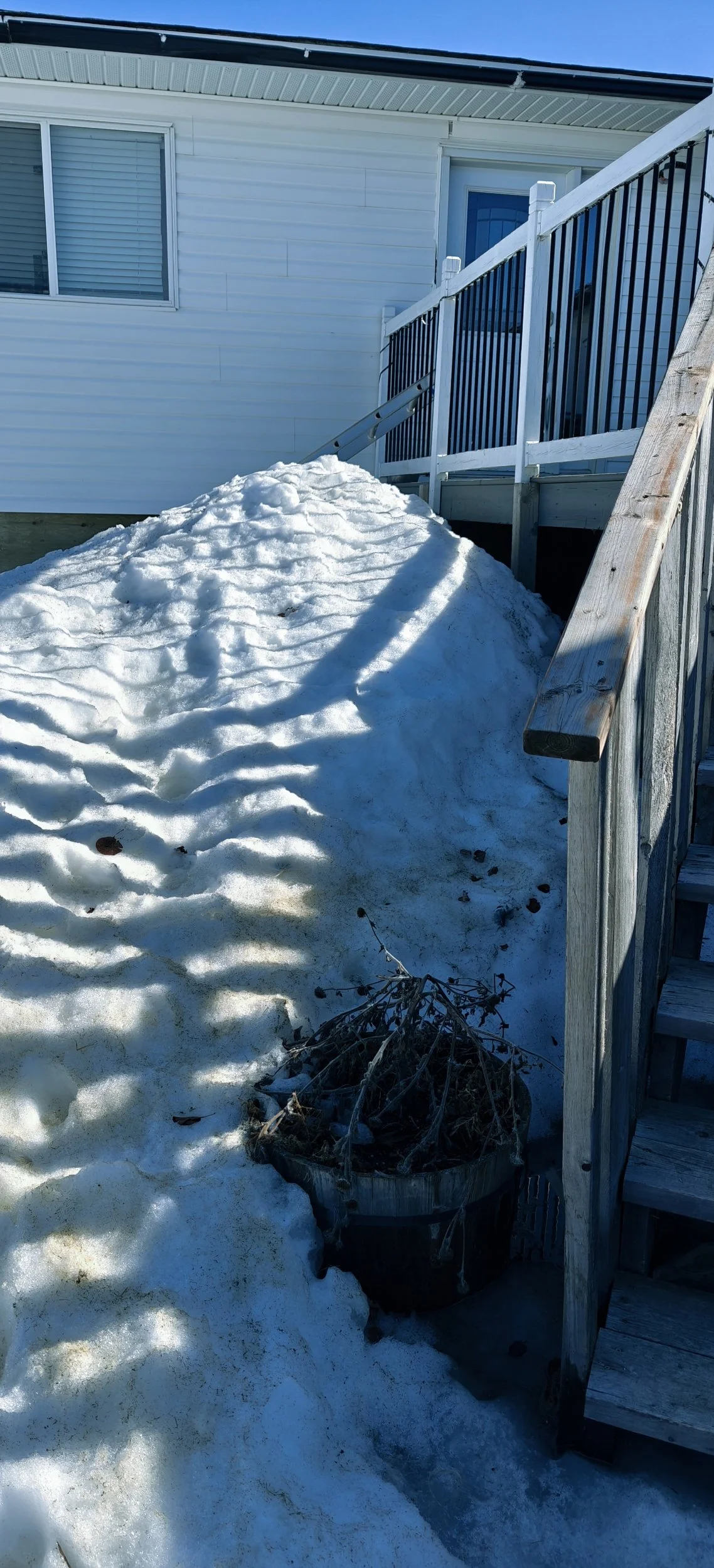
Receipts. Photo taken April 28.
Lately, I’ve been seeing signs that I might be sliding back into burnout. Because of this, I’m making an effort to cut down on work for the summer while still somehow moving my projects forward and keeping the bills paid. It’s a tricky balance.
So I might not post every week for the next few months. Which, I suspect, is fine with you—I mean, who doesn’t want a chance to feel like they can slow down and not miss out?
Then again, maybe I will. Because writing this blog isn’t just my way of staying in touch. It’s how I process, and how I record where I’m at. In its own way, it’s as therapeutic as writing my books or my music.
May you also find rest in this season, my friend.
If you’ve read any of my Peace Crossing books, I’m curious: did you notice the mistaken assumptions pattern before I did? Let me know in the comments!