Nail Your Log Line, Hook Your Reader
One of the most difficult parts of writing a book can be summarizing it in an interesting and succinct way when someone asks you what it’s about.
There are plenty of other difficult parts, sure. Plotting. Characters. Structure. Creating a satisfying ending. Making sure your conflict resonates. Finding a concept that can carry a whole book or series—or that won’t overflow the bounds of a short story.
What if I told you that all of these problems could be addressed (at least in part) by utilizing one simple tool: the log line?
Onward!
What’s a log line?
The term “log line” comes from the film industry, where it refers to a one-sentence summary of a story that’s used for pitching to producers and publishers. It captures the emotional hook, conflict, and core premise of the story in one or two sentences. (The descriptions of your favourite shows on streaming platforms are types of log lines.)
A well-crafted log line isn’t just important for pitching, though—it’s the basis for all future marketing copy, from book descriptions to hooks to ads.
And, if you develop it during your writing or revision process, it can save you hundreds of misspent hours and thousands of words by ensuring you have your key structural elements in place before you write yourself into a corner or discover your plot looks like Swiss cheese.
The log line is such a useful tool, in fact, that I recommend it to writers of any style—plotters, pantsers (discovery writers), and everyone in between.
It’s also the first (and most important) step of my Flexible Writer’s Framework for writing and revising stories.
How do you make a log line?
A log line includes all the important elements of the story: protagonist, antagonist, goal, obstacle (problem or external conflict), stakes, and often, a ticking clock. It also conveys genre (often through implication).
Some of these elements are optional, such as a ticking clock. However, including all six elements is going to ensure the most compelling and structurally sound story idea.
Let me give you an example to show you what I mean.
For the movie Frozen, the log line is:
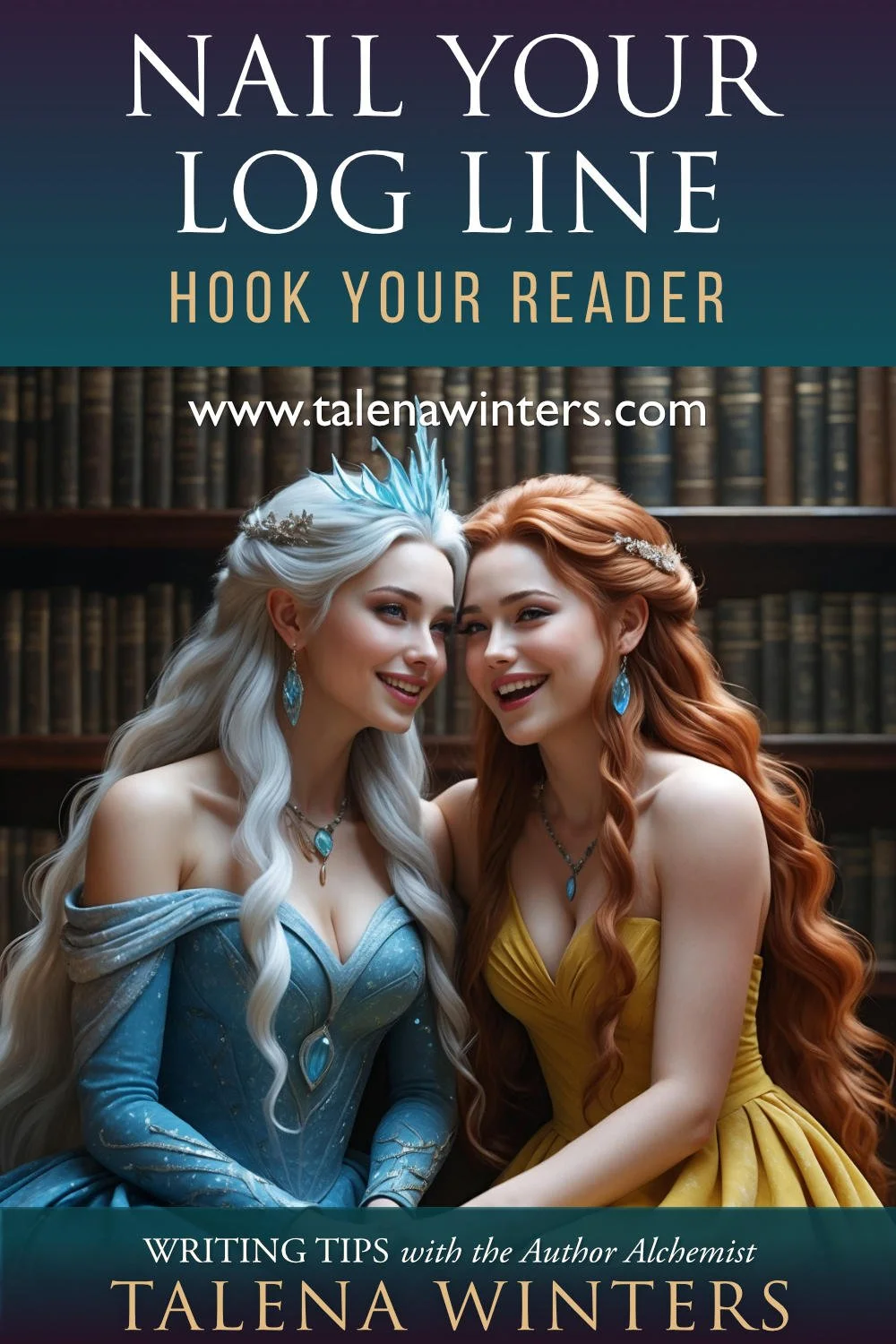
A sheltered and lonely Danish princess must save her country, their visiting dignitaries, and the fiancé she just met from freezing and famine after her reclusive older sister unleashes an unnatural magical winter and vanishes.
Kind of wordy, but log lines meant for plotting often are. Here’s what we’ve got if we break that down:
Protagonist: sheltered and lonely Danish princess
Antagonist: reclusive older sister with superpowers
Problem: The older sister unleashes an unnatural magical winter on the whole country, but didn’t stick around to fix it
Goal: Thaw the country, and the older sister’s frozen heart
Stakes: Everyone freezing or starving to death, including her new beau-slash-lifeline
Ticking clock: The amount of time before that happens
Implied genre: The magical aspects imply some kind of fantasy tale. The main characters being princesses and the romance angle implies it could be a fairytale.
Note that this log line didn’t mention anything about the love triangle, the betrayal, the supporting characters, nor many of the other cool aspects of the movie. It also didn’t use people’s names, but instead, used adjectives and nouns to tell us who they are and why they matter.
It did, however, subtly allude to the movie’s theme—only love can thaw a frozen heart.
There are all kinds of log line formulas, and I explore a few here. Also, I’ll be introducing my upcoming workshop on the Log Line later in this post, if you want to dive deeper.
Log Line vs. Elevator Pitch
While log lines are often used as another word for one-sentence pitch, I prefer to think of the log line as a plotting and story development tool, and separate the pitching aspects into a separate tool called the Elevator Pitch.
The “vs.” in this section heading might make you think of a Mortal Kombat street fight between these two concepts, but actually, log lines and elevator pitches are more like lovers walking hand-in-hand into the sunset. They’re deeply interrelated, but one is used for plotting, and the other is used for marketing.
An elevator pitch uses the same basic elements as a log line (often reshaped a little for intrigue), but can also include several other things:
Premise / cool factor: What makes this story unique or interesting?
Genre: Instead of implying it, state it point blank.
Comp titles, stories, or concepts: Use well-known tropes and bestselling stories mashed together to immediately intrigue.
Themes: Like genre, themes can be blatantly stated in a pitch instead of only alluded to.
For example, the elevator pitch for Frozen might look like this:
Frozen is a fantasy fairytale about two royal sisters whose bond is tested when the elder accidentally curses their kingdom with eternal winter. Think The Snow Queen meets Wicked, with themes of sisterhood, sacrifice, and the power of love to break even the coldest curse.
Note that while it drew from the log line, it didn’t include every element. Instead, it focused on the core conflict and the themes, as well as the “cool factor” and some comps to quickly capture interest.
That pitch is already pretty tight, but if you were selling this as a book at a live event (such as a con or book signing) or talking to an agent or editor, you might want to make it a bit more natural-sounding, like this:
“It’s about a sheltered young princess whose reclusive sister accidentally curses their kingdom with endless winter. Now, she has to find a way to break the curse before everyone—including her new prince fiancé—freezes or starves to death. At its core, it’s a fairytale fantasy about sisterhood, sacrifice, and love strong enough to melt even the coldest heart.”
“Here’s the key difference: your log line is for you. Your elevator pitch is for other people. Same DNA, different delivery.”
Be sure to mix up your pitches and experiment to find which parts of your story resonates most. Your story is a lot of things, and your pitch lets you play with featuring different aspects from the log line’s basic framework to appeal to different audiences.
Here’s the key difference: your log line is for you. Your elevator pitch is for other people. Same DNA, different delivery.
For a deeper dive into developing your elevator pitch, check out this post. We’ll also be covering how to turn your log line into an elevator pitch in my Log Line workshop. (We’ll get there next, promise!)
Want to learn more?
I have two ways you can learn how to develop your own log line creation skills.
Read previous blog posts:
Learn how to use the log line for plot development and pitching:
Take my upcoming class:
Do you want more in-depth help with your log line skills?
Do you want one-on-one help developing your story’s log line?
My log line class is for you. Read on to learn more!
Workshop: Nail Your Story in One Sentence with the Log Line
About the workshop:
If you can’t describe your story in one sentence, chances are you don’t really know what it’s about.
In this class, you’ll learn to distill your entire plot into a single-sentence log line—a powerful tool to test ideas, guide your draft, steer revisions, and sell your story. Whether you’re a plotter, a pantser/discovery writer, or somewhere in between, use a log line to save time and avoid frustration while writing, then pitch with confidence!
Who this is for: Fiction and creative nonfiction writers
Class type: Live interactive online workshop
Length: 2 hours
Date: September 18 @ 10 a.m. MT
What you’ll learn:
How to use the log line to:
Spark and test story ideas before you invest months of writing
Spot plot holes before (or after) they derail your draft
Stay focused and confident while drafting or revising
Rescue a broken story with a single guiding sentence
Write pitches, queries, and book descriptions that stand out
This workshop will be packed full of value, including a recording you can watch again and again, a PDF log line worksheet you can re use to craft future log lines and pitches, and the class slides.
The best part?
You’ll walk away with a single, cohesive sentence about your story that you can use for plot development, revision, and marketing.
If you’ve ever struggled to explain your book without tripping over your words, this class will change the game for you.
Early bird pricing until September 1! Get 30% off!
Want to learn more and reserve your spot?
Next week, I’ll be back with a post that goes deeper into the subtle differences between a premise line, log line, tag line, hook, and elevator pitch. (Why do we have so many confusing terms in publishing, amiright?)
Until then, happy wordsmithing!