Log Lines, Taglines, Hooks & More: The Essential One-Line Tools Every Author Needs
One of the confusing things in publishing that can overwhelm writers (and there are many) is how many terms are used to describe single-sentence summaries of our stories. What, exactly, is the difference between a premise and a hook? Aren’t a tag line and a shout line the same thing? What the heck is a log line, and what separates it from an elevator pitch?
And what do you even need any of these for?
As it turns out, each of these terms is the name of a vital tool to have in your writing and marketing toolkit. And since they’re all interconnected, it’s little wonder that they’re often used in interchangeable ways.
Today, I’m going to untangle this knotty mess (at least a little!). I’ll define the terms, explain what each tool is for, and also show you how and why to use each one for your own story.
Onward!
Building Your Story
I want you to think of your story like a house you’re building. Each of the terms we’re talking about today is a tool designed for a different part of the process between “initial concept” and “move-in”—meaning, diving in and reading your book. Some of the tools are for the planning and building stages, and some of them are for selling the final product (also known as “connecting your book to a reader who’ll love it” if the term selling feels too icky for you). And all of those stages connect.
It’s because these terms connect that they can be so confusing. So let’s create some clarity and put them each in their proper place.

Courtesy of Jason Leung via Unsplash.
The Premise (or Hook): The Idea that Starts it All
The premise is whatever hooks you into wanting to write this story in the first place—and it’s what will hook others into wanting to read it.
When you want to build a structure, you start with a basic concept: you want a four-bedroom family home, a sleek skyrise office complex, or luxury condo apartments.
“The premise conveys the basic emotions, genre, or what makes the story interesting in only a few words.”
With your story, the premise conveys the basic emotions, genre, or what makes the story interesting in only a few words.
For example, the premise of the TV show Firefly could be honourable outlaw cowboys in space. The premise of the show Castle would be a bestselling writer solves murders with an NYPD detective. (Why, yes, I am a Nathan Fillion fan, why do you ask?)
Guidelines for creating a premise:
Comp titles (if used) or concepts need to be instantly recognizable
The included concepts should have some interesting tension between them
You should instantly see how a mashup might work (or at least want to know what the creator has in mind)
Familiar stories, archetypes, tropes, or settings should be presented in fresh or unusual ways
All of these need to combine to make the “cool factor” blatantly obvious
Here are a few examples:
Jane Austen with zombies (Pride and Prejudice and Zombies)
The Little Mermaid, but gender-swapped
A reality show where teenagers are forced to compete to the death (The Hunger Games)
Hunger Games in space
A theme park with real dinosaurs (Jurassic Park)
Jurassic Park, but with vampires
An alien with godlike powers grows up human and heroic (Superman)
A mother and daughter grow up together in a quirky small town (Gilmore Girls)
Gilmore Girls meets Superman
(I just made most of those up, but boy-howdy, would I read or watch the heck out of that last one.)
For my epic YA fantasy Rise of the Grigori series, the premise is “mermaids save the world from the demon apocalypse.”
Notice that, just like the premise of a structure is both the seed of the idea and likely to feature heavily in every stage of the process thereafter, the same is true of a story premise—not only is it the “cool factor” that gives shape to the story vibe before you start writing, you’ll keep using it as you develop your story and, later, to interest your readers in it. (Also known as marketing.)
So, the premise:
Shapes your story vision
Gives the story vibe
Includes the “cool factor”—the seed that makes you want to write the story in the first place
In real-world terms, if you’re chasing down an agent and they’re brushing you off as they’re about to get in the elevator, the premise is what you’d yell at them as the door closes to get them to let you in and listen.
(Please don’t chase down agents like this. They don’t love that. But you will include your premise when attracting an agent—or your ideal readers. We’ll talk about that later.)

Courtesy of Richard Heinen via Unsplash.
The Log Line: Your Story’s Design Brief
Once you have the overall vision, it’s time to get specific and make a plan.
For a building, this is the design brief. Instead of “four-bedroom family home,” it becomes “a 4000-square-foot Craftsman-style four-bedroom bungalow that takes advantage of a great view, with an indoor pool, dining room, breakfast nook, and a home theatre room.”
For your story, this is the log line—a one- or two-sentence encapsulation of all the key elements of your story. In other words, take that premise and give it form.
A log line includes all the basic ingredients or elements you’ll need to have to craft a compelling and satisfying story based on your original premise. These include your protagonist, primary antagonist, goal, obstacle, stakes, and a deadline. It also conveys the genre (usually implied, not stated).
“A log line includes all the basic ingredients or elements you’ll need to have to craft a compelling and satisfying story based on your original premise.”
Some of these elements are optional, but including all seven of them ensures you have a plan you can build into a finished structure without it collapsing on itself—and that others will actually want to read.
Creating a log line before you write is a great way to test story ideas, to see if your story scope is appropriate for your goals, and to see if any important elements of your structure are missing. It also gives you a guiding light to return to if you get stuck while plotting, writing, or revising.
(But it’s okay for it to be flexible. Stories often change during drafting because you get a cool new idea that would make it even better. If that’s the case, no worries—just update your log line.)
Your log line is also the basis of literally everything else you’ll need to build and sell your story. It determines the shape of your plot (whether you outline or discover as you go) and provides the key elements of your marketing materials—including everything we’ll talk about in the rest of this post.
Crafting great log lines is actually a pretty in-depth process beyond the scope of this post, but I already have a couple of resources for you.
Blog posts:
My log line workshop, “Nail Your Story In One Sentence with the Log Line”. More about that in a minute.
Elements of a log line:
protagonist with a need
antagonist with a need
goal
obstacle/external conflict
stakes
deadline
conveys genre (often implied, not explicit)
Here are a few examples:
Pride and Prejudice and Zombies
A headstrong young woman seeking security must join forces with a proud monster-hunter seeking respect to find love and survival, but their clashing pride and prejudice—and the relentless undead—threaten to destroy them both before zombies overrun their world.
The Little Merman
A headstrong, idealistic young merman longing to become human saves a human princess and bargains with a ruthless, power-hungry sea wizard with designs on the throne for the chance to be with her—but if he can’t fulfill the terms of the bargain by the three-day deadline, he’ll need to choose between his beloved’s life and his own.
Gilmore Girls meets Superman (Small-Town Supergirl)
(You wanted to see what this idea looked like too, right?)
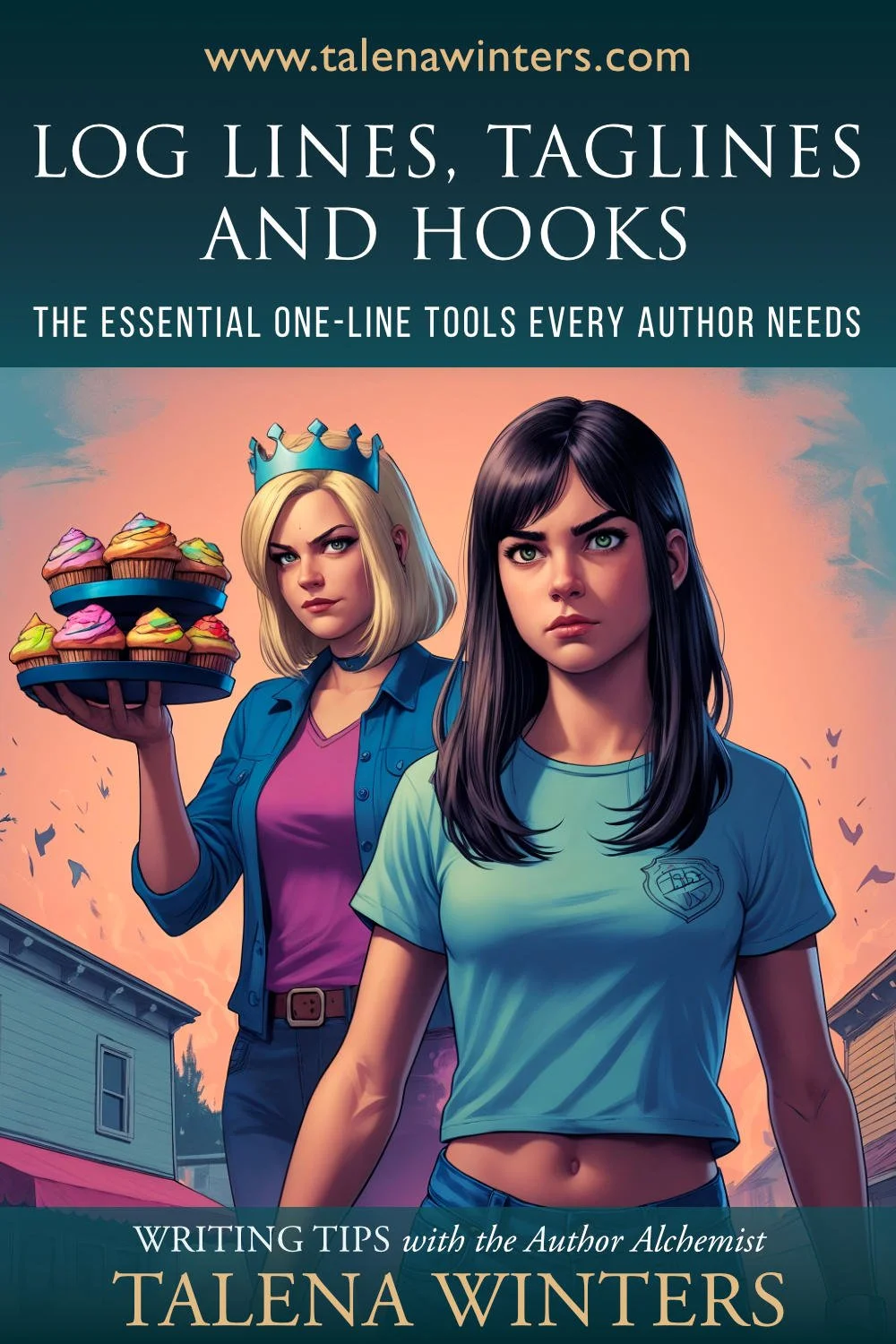
When her nosy, power-hungry neighbour plans to take over the entire town with mind-control muffins at Founders’ Day, a sharp-witted, sarcastic teen longing for a normal life must expose her secret superpowers to stop the scheme or lose her family and hometown forever.
In our real-world scenario, this is the tool you use when you’re brainstorming new stories, guiding your outlining, writing, or revision process, and developing the marketing copy you’ll use in all the future steps.
Log Lines: The Author’s Multitool
This post is about distinguishing different types of one-line tools for your story, not the stages of story development, so I’m going to skip over the next stage of building both houses and your story: for buildings, this would be the blueprint, and for stories, it’s the outline (no matter how short or un-written-down).
However, if you’d like more information about how the log line can help you develop your story, whether you’re a plotter, pantser, or somewhere in between, check out my interactive workshop, “Nail Your Story in One Sentence with the Log Line”. In the class, I teach you how to use the log line as a brainstorming, outlining, writing, and revising tool, as well as how to turn it into a great pitch.

Courtesy of Uladzislau Petrushkevich via Unsplash.
Tagline or Strapline
A tagline (sometimes called a strapline) is a short, punchy phrase used on book covers and movie posters that captures the vibe, genre, or “cool factor” of the story in a not-too-specific but very intriguing way.
Think of Alien: “In space, no one can hear you scream.”
In other words, the tagline is a marketing tool based on the premise, the headline (which we’ll get to next), and/or the log line.
“A tagline is a short, punchy phrase that captures the vibe, genre, or ‘cool factor’ of the story in a not-too-specific but very intriguing way.”
For homes, this tool would be the headline of the real estate listing, only cleverer. (Realtors often use boring headlines like the price, instead of something more emotional like, “A room with a 100-story view.”)
For Pride and Prejudice and Zombies, the poster tagline was “Bloody lovely.” Another tagline used to promote the movie was “Slay with pride. Kill with prejudice.”
(Honestly, I’m not sure why I chose this movie as an example, other than it’s an unexpected mashup—I love Pride and Prejudice, but I hate zombies, so I haven’t watched this, and I’m not sure I will. But the concept is super original.)
Guidelines for great taglines:
Make them:
Short
Punchy
Intriguing
Convey the “cool factor”—whatever makes the story or premise interesting
Example taglines:
Here are the real or possible taglines for some of our other sample premises from earlier:
The Little Merman: “Love costs everything,” or “Dare to love. Dare to lose,” or “Love will drown him.”
The Hunger Games: “The world will be watching.”
Jurassic Park: “Life finds a way.”
Superman: 2025 version: “Look up.” 1978 version: “You’ll believe a man can fly.”
Small-Town Supergirl: “Small town. Big powers. Zero chill.”
In practice: Use this on your book cover and your ad graphics. Be sure to test to see what resonates most with your audience—or use slightly different versions for different audiences that would love your story.
Courtesy of Oliver Sharp via Unsplash.
Hooks, Headlines, and Shoutlines
A hook is any element in your marketing copy or book description that grabs attention and makes a reader want to know more. It’s the reason someone stops scrolling, opens a page, clicks your ad, or keeps watching your video after the first few seconds. That’s why I lumped it in with the premise earlier.
“A headline goes at the top of your book description to catch a reader’s interest and entice them to keep reading.”
Hooks are a broad category that incorporates anything that gets attention. So, actually, a tagline is a type of hook.
In book publishing, the term hook is often used interchangeably with a specific type of marketing line: the headline, also known as the shoutline in some publishing circles. A headline is another type of hook that’s slightly more descriptive than a tagline—but only slightly.
A headline goes at the top of your book description to catch a reader’s interest and entice them to keep reading. It can also be used in marketing copy, on ad graphics, and more.
To break it down:
Hook: Anything that draws attention—could be a sentence, a question, a punchy phrase, or a concept. It includes taglines and headlines.
Tagline / Strapline: A punchy, memorable, and brand or story-focused phrase meant to stick in the reader’s mind and convey the “cool factor” of your story, often on the cover or in advertising.
Headline / Shoutline: A short, punchy headline used in your marketing copy, book description, or ad that’s designed to make someone stop and read.
Unlike a tagline, a headline can be a little more explicit about your story. However, it’s job is still only to intrigue and get a reader to move on to the full description, so resist the urge to be too explicit.
Good headlines:
Allude to the basic premise or “cool factor”
Build suspense or stakes as they go
Have an intriguing twist
Convey genre
Example headlines:
Pride and Prejudice and Zombies: “Love, manners, and undead mayhem collide in Regency England.”
The Little Merman: “To win her love, he’d risk his life,” or “He’d do anything for her love,” or “He’ll risk everything to win her love. He’ll lose everything if he fails,” or “Three days. One choice. A love worth drowning for.”
Small-Town Supergirl: “High school is hard. Saving the world is harder,” or “She’s needs a B in Chem—and an A in Saving the World.”
Jurassic Park: “An adventure 65 million years in the making.”
In practice: Use headlines at the top of your book descriptions or wherever you want someone to stop and pay attention—your ad graphics, social media posts, or pitch materials. Experiment with different phrasing and placement to see which resonates most with your audience.
Courtesy of Phil Hearing via Unsplash.
Elevator Pitch
The elevator pitch is similar to a log line, but instead of being used as a plotting and revision tool, it’s a marketing tool.
These two are so similar, in fact, that “elevator pitch” and “log line” are often used interchangeably, especially in the film industry. However, since the log line is for you, and the pitch is for other people, you need to make some adjustments.
The elevator pitch is where all the previous steps come together to create an appealing pitch to sell your story. Like the other marketing tools, it’s main job is to interest someone in picking up your story or learning more.
“The elevator pitch is where all the previous steps come together to create an appealing pitch to sell your story.”
In other words, if you actually make it onto the elevator with an agent, this is what you say to get them interested in your story before they get off on their floor. (Or, more likely, what you include in your query letter.)
It can also be tweaked into an easy-to-say version to interest a potential reader at a market or book signing so they pick up the book and read the back cover.
An elevator pitch can include:
The same basic elements as a log line (protagonist, antagonist, goal, stakes, obstacle, and deadline)
The premise / cool factor
Genre (stated explicitly instead of implicitly)
Comp titles, stories, or concepts
Themes
Example elevator pitches:
Pride and Prejudice and Zombies
In zombie-ravaged Regency England, fiercely independent Elizabeth Bennet must secure her future and protect her sisters, but her growing attraction to the proud monster-hunter Mr. Darcy collides with social prejudice, personal pride, and relentless undead hordes; if she cannot overcome her distrust and join forces with him before the zombie outbreak overwhelms Hertfordshire, she risks losing both love and survival in this horror-romance parody.
The Little Merman
The Little Merman is a sweeping romantic fantasy retelling of the classic fairytale—with the roles reversed. A headstrong young merman, desperate to belong in the human world, bargains with a ruthless sea wizard to trade his angelic voice for a chance at love with a princess on land. But with only three days to win her heart before the spell breaks—and his life and his mother’s kingdom are forfeit—he must decide how far he’s willing to go for love.
Jurassic Park
Jurassic Park is a high-stakes sci-fi thriller where a billionaire’s dream of a dinosaur theme park becomes a nightmare. When the creatures escape, a small group of scientists and kids either figure out how to survive the prehistoric predators—or become lunch. Think cutting-edge science meets monster movie mayhem.
Small-Town Supergirl
In this quirky small-town adventure, a sharp-witted, sarcastic teen with superpowers longs for a normal life—as normal as being raised by a single mom you’re also kind of raising can be. But when her nosy, power-hungry neighbour—who’s part PTA queen, part mad scientist—plans to take over the town with mind-control muffins at Founders’ Day, she faces the choice of remaining safely “normal” or revealing her secret superpowers to stop the scheme. Think Gilmore Girls meets Superman, with a dash of Buffy the Vampire Slayer camp. It’s a coming-of-age story about family, friendship, and the chaos of growing up super that’s packed with humor, heart, and over-the-top action.
(My goodness, do I ever want to write this now.)
As you can see, the elevator pitch shares a lot of DNA with everything else we’ve talked about—it’s like they all got together and had a super-marketing baby. :-)
As far as our house metaphor is concerned, this is the real estate listing (in conjunction with a killer cover photo deck). The next stage before your buyer makes an offer (the house tour) would be your book description.
For more about how to create your own elevator pitch, refer to my blog post “Your Story in a Single Sentence Part 2: The Elevator Pitch”.
Also, check out my upcoming live Log Line workshop. We’ll be covering how to create not only a log line for your current work in progress (and doing it right in class), but also a compelling elevator pitch to hook readers, agents, and your skeptical big brother.

Courtesy of Kai Rohweder via Unsplash.
Putting the Tools to Use
Just like building a house, telling a story takes the right tools at the right time. Now you know what each of these tools is for, you can reach for the one you need instead of fumbling for the hammer when it’s really time for a paintbrush. Use them to build, polish, and sell your story—so readers can finally “move in.”
If you’d like guided practice (and feedback!) on your own story, come join my upcoming Nail Your Story in One Sentence workshop. We’ll hammer out your log line together, then shape it into an elevator pitch you can actually use with readers, agents, and marketers. Think of it as story-building with a toolbox that finally makes sense.
Okay, now that you’ve got your tools sorted out… go make some magic!